 | KYRGYZSTAN : A first study of Kyrgyz handcraft from Naryn Oblast for markets in the UK. Onevillage.org |
|
 ONE VILLAGE CLICK TO: ONE VILLAGE CLICK TO:
.gif) Our online shop Our online shop
.gif) Basics Fair trade?
Other info pages Basics Fair trade?
Other info pages
|
.gif)
|
|
 Handcrafts of Naryn Oblast, Kyrgyzstan
With reference to export prospects into the UK
A One Village study by Roy Scott, July 2001
This appraisal is the result of an approach to One Village by Roza Otunbayeva, (then) Ambassador in London of the Kyrgyz Republic [and since 2010 the President of Kyrgyzstan], to explore prospects for marketing in the UK the traditional craft of Naryn Oblast.
The work was undertaken as a development cooperation project by One Village, with the financial and logistical support of BESO (British Executive Service Overseas). It has been possible also because of the support of the administration of Naryn Oblast, and particularly of the governor Mr Askar Salymbekov.
The visiting consultants: Rosalind and Roy Scott, July 14-29, 2001.
There is a relatively flat plain in the north of Kyrgyzstan, where stands the capital Bishkek and most of the arable land, but apart from that most of the country is predominantly mountainous. Kyrgyzstan hosts several of the world's highest mountain ranges including much of the Tian Shan (Celestial mountains). Ninety percent of the surface area is land over 1,000 metres above sea level. It features spectacular landscapes of valleys, vast high plateaus, forests and meadows, and ever-visible snow covered mountains. The population of Kyrgyzstan is less than 5-million people; the national average density of approximately 24 people per sq km is one-tenth that of the average in the UK.
Kyrgyzstan was formerly a part of the USSR, and its people generally appear to have faired well as part of that commonwealth. Independence came abruptly in 1991, bringing enormous changes in economic culture for which the new country was not at all prepared. In contrast to a structured society in which everyone was more or less guaranteed a livelihood, the Kyrgyz people now find themselves responsible for their own individual economic survival. This change is especially difficult because there is limited economic activity throughout the country and access to capital is not at all even. The banking sector is very poorly represented.
GDP per capita in Kyrgyzstan is US$380 p.a. (World Bank, 1998), which puts the country decidedly into the list of the world's poorest according to this measure. What is more, GDP is not at all evenly distributed with nearly 50% of GDP directly benefiting only 20% of the population. The Kyrgyz people are very well educated, with almost 100% literacy and high levels of skills.
It seems generally recognized, even in the most selective Bishkek shops, that the best quality large handcrafts in Kyrgyzstan come from Naryn Oblast. What are these articles?
The felt-making for yurts is traditionally done within each family, using wool from their own sheep. Felts for the walls and roof of the yurt is plain, without decoration, but felts for the floor of the yurt are often decorated. The finished felts are effective and good-looking, but making them is hard work. The raw wool is taken from the sheep, is then cleaned and thoroughly picked over to remove any impurities or unevenness. The unspun wool is then arranged thickly on top of a straw mat, known as a «chiy mat» (a mat which also has practical use as a divider and for storage in the yurt). At this point, the thickness of the wool is about 20cm or so. Now the process of felt-making begins in earnest with the beating and hammering of the wool, pressing and compacting the raw wool into the resulting felt. This beating is done utilizing all available means – sticks, the forearms of the makers, rolling, tightening with ropes, kicking. Small amounts of very hot water are added to help with the adhesion, and the whole process has to be carried out in hot conditions – outside in the summer months.
There are two different techniques by which felts can be made decorated and suitable for floor coverings: ala-kyiz and shyrdak. These decorated rugs are considered the articles with most potential to pioneer exports.
For the ala-kyiz, considerable artistic creativity is required in the actual construction of the felt.
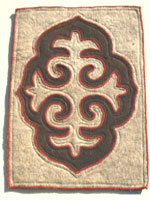
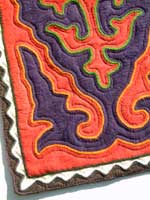
An alternative process in felt rugs produces what is known as a «shyrdak». The decoration on this rug is by means of appliqué. The shyrdak has a base layer, usually dark coloured felt, onto the top of which is sewn a second felt layer, this containing the patterning. This second layer will consist of more than one piece of felt, because the entire surface of the shyrdak is built up to an equal level. Thus on each rug positive design images are always paired with the negative of the same image, in a second colour. In cutting out the designs for application, no felt is wasted because the makers always produce a duplicate rug of exactly the same shyrdak design, but with reverse colours not used in the first shyrdak.
These rugs often carry a range of several colours and so the cutting out for the appliquι becomes increasingly complex involving several pieces of felt. Colours are sometimes contrasting natural colours received from the wool of a choice of sheep; or otherwise are dyed colours produced from chemical or organic dyes (what is described as «organic» is often a mixture of organic and chemical dyes). Some shyrdaks will include both dyed and undyed wool felt. Further skill in colour coordination comes into the choice of thread for the stitching, which is a prominent feature of the finished shyrdak. The stitching also adds relief to the otherwise flat surface.
Traditionally, shyrdak patterns are always based on shapes from the natural and spiritual environment in which the makers find themselves, and the design taken as a whole represents the harmony and coexistence of all the elements of that perception.
Most producers are not individually known in that way, yet for them the income generating potential is especially important. For the families of traditional herdspeople, artisan production might provide one of few sources of cash income. This can have great value in maintaining the economic life of remote places and helping to avert a population drift into towns and urban areas. Individual artisans working like this away from main routes, need supportive marketing vehicles.
Since 1996, an extension of the Helvetas rural assistance programme in Naryn Oblast has supported an initiative that was started then by some of the rural women in the areas around the Naryn Oblast towns of Kochkor and Jumgal. These women had been making the traditional rugs but realized that they lacked skills in marketing. The Helvetas assistance began by helping the women to put together an exhibition of their rugs in Bishkek, and from that came encouragement and practical feedback. One of the lessons learnt straightaway was that sales success only comes from quality products, so for the next making season training workshops in sewing skills were arranged in Kochkor. More than 100 women attended, testament to the artisans' desire to improve the saleability of their product. By the following year, the number of women involved in this emerging collective reached 200, and it became clear that some sort of formal organization should be incorporated to join the women together to increase livelihoods through effective production and sales, and to defend their interests. In this way, helped with technical advice and assistance from Helvetas, the women themselves formed their NGO «Altyn Kol» (which means, «the Golden Hands»).
Today over 300 women are members of this independent society, and its members are to be found all over Naryn Oblast. In each participating village is an elected coordinator, and groups of about five villages work together in a zone. Administration is done from Kochkor, where Altyn Kol also operates a shop. Most members, from all of Naryn Oblast, meet at least once a year for the annual meeting where the affairs of the society are reviewed and the officers are elected/re-elected.
Altyn Kol is unique in its scale; it belongs to the women themselves, and therefore appears to be the body with the most potential for organizing production of the significant craft articles of Naryn Oblast. As a large membership organization of craftmakers, with transparency built in to its operating systems, this organization is most likely to serve the best interests of the artisans.
Sales of Altyn Kol continue through exhibitions in Bishkek (now held twice annually), to tourists and others through the shop in Kochkor, and through other trading organizations – especially an export promotion organization for Kyrgyz craft known as «Kyrgyz Style». Altyn Kol quality is recognized as among the best. Although independent from Helvetas, Altyn Kol continues to benefit as appropriate from Helvetas advice and support services. Helvetas is ready to assist Altyn Kol as it develops its own capacity for direct marketing both domestically and abroad.
The society Altyn Kol is currently quite exposed to the fortunes of Kyrgyz Style, because about one third of its total sales go to this organization. Some problems over slow payments by Kyrgyz Style to the artisans' organization have been reported.
Kyrgyz Style have a strong link with the American NGO Aid to Artisans, and through that have made efforts to test export potential for Kyrgyz handicrafts in the US – particularly the shyrdaks from Naryn. Aid to Artisans has helped to get the shyrdaks highlighted in stylish American media but says their sales experience suggests difficulty in marketing the product in its traditional form into the US market. Aid to Artisans is therefore working through Kyrgyz Style to implement changes developed by American designers – for both the colouring and the design characteristics of the traditional product. Taking elements from the traditional designs, the designers of Aid to Artisans have rearranged these to form striking graphics to be executed in colourschemes radically different from the Kyrgyz originals. Critics will say that this process places at risk the cultural heritage and deep harmonious spiritual symbolism contained in the product, but the propagators argue this is unavoidable if the product is to be acceptable in that marketplace. Perhaps markets elsewhere might yet offer more hope for the traditional article.
Independently, there have been other attempts to sell these articles in the USA, including a website that offers a range of designs. And as well as the USA, it is known that shyrdaks have been exported to other places – including Switzerland and some other European countries – but no one in the world appears to be repeat ordering on a regular basis.
The price paid to the maker includes materials and labour. There are three price bands - one for undyed shyrdaks, one for shyrdaks dyed with normal chemical dyes, and another price for when the dyes are organic. When a rug is a combination – for example a mixture of undyed and dyed – the price is calculated on a pro-rata basis. For example, a rug 75% undyed and 25% organic dyes, means that 75% of the area of the shyrdak is paid for at the undyed rate; 25% at the organic dyed rate.
Downward adjustments to this basic price are then made to reflect the amount and quality of work involved, taking into account –
The shyrdak is not accepted at all if significant downward adjustments are appropriate.
This scheme penalizes poor quality. An alternative more positive and encouraging formula would be to have a lower basic price and pay extra for quality improvements, but such an approach would assume and make acceptable a lower quality baseline whilst for export high quality must be supplied without exception.
On top of the price paid to the artisan, the society Altyn Kol then adds its markup, which depends on the sales route, whether Altyn Kol exhibitions, the Altyn Kol shop, or products made to order (such as for an export order).
There is a further setback to the cost, and this is caused by a requirement by the Kyrgyz Ministry of Commerce that each individual shyrdak requires an export licence. The reason behind this is to try to prevent (or at least control) the export of special works of art and antiquities. The fee for each licence, for each individual shyrdak, is US$3; and there is also a cost in making the applications because each application has to be accompanied by a photograph of the particular shyrdak. Representations have been made through the Kyrgyzstan Ambassador in London to see whether this tax can be changed because it seriously damages the potential for artisans to sell their product in the world markets. On top of this Ministry of Culture licence for each individual item, there is also a flat fee per consignment of US$10.
Adding together for a significant consignment –
the resulting price per square metre for shyrdaks works out at about sterling £82.84.
If the consignment is less than 1,000kilos, the costs per m2 will be higher. Higher freight rates and handling costs will apply. The Ministry of Culture licence also especially penalizes small shyrdaks, because the fee is the same for each shyrdak regardless of size. A smaller shyrdak, 1m x 0.75m, would therefore need to sell for about £68.
Socially-proactive importer/wholesaler means an importer specially set up to support social progress enterprises such as is described as the society Altyn Kol. Such an importer/wholesaler works on much lower markups than commercial norms [see, for example, One Village]. The eventual sales price of shyrdaks through a normal commercial importer are likely to be significantly higher.
There is a possibility to reduce these prices if the Ministry of Commerce withdraw their export tax and if the UK socially-proactive wholesaler is prepared and able to operate on a margin even lower than their norm.
© Copyright, One Village UK, 2001
·············································
Kyrgyzstan shyrdak cushion covers:
|
.gif)


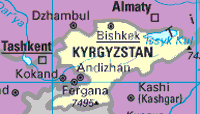
 Naryn Oblast
.gif)
.jpg)

